


What Is Pharmacy?
Pharmacy combines science, healthcare, and professional practice. Pharmacists are professionals who work in many areas including community pharmacy, hospital pharmacy, industry, research, education, and emerging areas.
Pharmacists play an important, and expanding, role in healthcare systems. Pharmacists are medicines experts and use their knowledge, skills, and expertise to ensure safe, legal, and effective practice. They also support safe and regulated manufacturing in the industrial setting.

What is the Master of Pharmacy Course?
The Master of Pharmacy programme is a five-year programme which integrates periods of experiential learning placement.
Upon successful completion of four years of study, students will obtain the Bachelor of Science (Honours) in Pharmacy. With successful completion of the fifth year of study, students are awarded the Master of Pharmacy.
To be eligible to apply to register to practice as a pharmacist in Ireland with Pharmaceutical Society of Ireland (PSI), successful completion of all five years of study is required. The MPharm programme is a regulated programme, meaning it adheres to strict guidelines and competency standards called the Core Competency Framework for Pharmacists set by the PSI. These standards ensure that graduates develop and demonstrate specific competencies required for safe and effective practice.
About
This programme is specifically designed to prepare students for modern practice by covering science, healthcare, professional practice, research, leadership, along with experiential placement, in an integrated way. Patient care and professionalism are central to the programme, in all its teaching and learning activities.
The programme design is the result of the collaboration of a multidisciplinary team that includes experts in science, pharmacy practice, health science, health promotion, research, business, and leadership. Feedback from professional pharmacists across the sector, both nationally and internationally, has also shaped the programme. This ensures it will meet professional standards and addresses the evolving needs of the healthcare environment. Becoming a pharmacist requires clear understanding of science and innovation. It also requires skills in patient care, professional practice, and working as part of a multidisciplinary team. There is a strong demand for pharmacists in Ireland and many opportunities are arising in this evolving sector.
Six streams of learning and training have been built, that will be delivered to students throughout their time on the programme in an integrated way. These streams incorporate a range of subjects spanning (bio)pharmaceutical science, biochemistry, pharmacology, therapeutics, pharmacy practice, professional skills, business and leadership, health and health promotion, and research.
From the beginning of the programme, a focus is placed on reflective learning and professional skills development that prepares students for pharmacy-based practice. Students will be encouraged to complete other learning activities to support their personal development including volunteering, research, and involvement with healthcare students in health promotion campaigns.
Experiential Placement
In the MPharm programme, experiential placement is a critical component designed to provide pharmacy students with hands-on practical experience in real-world healthcare settings. Under the supervision of a registered pharmacist, students gain insight into patient care, medication management, interprofessional collaboration, and the ethical responsibilities of the profession.
Beginning in second year, these placements allow students to apply their academic knowledge in community and hospital pharmacy environments. Placements in fourth year allow students the opportunity to work in a patient-facing, non-patient-facing, or emerging role — for example, in the pharmaceutical industry. The final placement in fifth year is based in a patient-facing role to prepare students for professional practice.
Professionalism, Code of Conduct and Fitness to Practice Requirements:
Pharmacists play a vital role in patient care, helping individuals manage their health and wellbeing. This is a trusted role in the healthcare sector and carries significant responsibilities to ensure public safety and confidence in the profession. Pharmacists work to the highest professional standards and in full compliance with the regulations set by the Pharmaceutical Society of Ireland (PSI) and the Pharmacy Act 2007. During their education and training, pharmacy students must uphold these standards through their academic and experiential learning experiences, where they will encounter members of the public.
Students in the Master of Pharmacy programme will be expected to behave professionally and responsibly, with a Professional Code of Conduct for Student Pharmacists in place at the University. Other policies and procedures that must be adhered to include the Fitness to Practise policy and attendance procedures. These protocols support students in completing the Master of Pharmacy programme, meeting the Core Competency Framework for Pharmacists, and developing their professional identity. Pharmacy students must uphold these standards through their education, training, and experiential learning experiences where they will encounter members of the public.
Garda Vetting:
To ensure that applicants are fit to undertake this programme they are subject to Garda vetting. Students will be provided with information regarding vetting upon registration.
- Applicants will be provided with relevant forms and documentation for vetting within Northern Ireland and the Irish Republic by SETU.
- It is mandatory for applicants who have resided abroad for a period greater than 6 months from the age of 12 years to provide SETU Waterford with a Police Clearance Certificate from those countries.
- Placements and practice visits can only be arranged for students on receipt of satisfactory clearance.
Occupational Health:
As part of the registration process for the Master of Pharmacy programme, each student will be asked to complete a medical declaration and take part in a medical screening process. These steps are to ensure readiness for patient facing activities during placement . If the student is unable to complete the process, we will provide guidance on alternative programme options.
MPharm applicants are encouraged to declare any health, wellbeing or fitness-to-practice concerns that might affect their ability to meet professional practice requirements. With the applicant's consent, the Health & Safety Office will review this information to identify any reasonable accommodations and supports for placement. If supports cannot be provided, we will hold an open discussion and where possible, we will facilitate alternative programme options.
Health Screening Process and Cost
Students undertaking the MPharm programme must complete a mandatory health screening process to meet the health and safety requirements for experiential learning placements. Students are responsible for the cost of the initial screening assessment and any additional blood tests, vaccinations or follow-up appointments required. The total cost will depend on the student’s vaccination history and individual screening requirements.
Information on the required documentation and relevant timelines will be provided during student induction.
New contact email
For all your questions, please contact [email protected].
Note: This is a shared mailbox, so please do not include any personal or sensitive information. We will endeavour to respond within 5 working days.
Subscribe to our newsletter
Year 1
| Semester 1 | Semester 2 |
|---|---|
| Foundations of Pharmaceutical Chemistry | Molecular Biology and Human Genetics |
| Pharmacy Practice 1: The start of the professional journey | Pharmaceutical Formulations and Maths with Statistics |
| Human Anatomy and Physiology | Introduction to Research Methods and Data Analysis for Pharmacists |
| Cellular Biochemistry | Pharmacology 1 |
| Physical Chemistry for Pharmacy |
Year 2
| Semester 3 | Semester 4 |
|---|---|
| Pharmaceutical Chemistry: Drug Design, Synthesis and Analysis | Infection and Immunity |
| Body Systems: Cardiovascular and Renal | Body Systems: GI, Hepatic and Respiratory |
| Pharmacology 2 | Clinical Biochemistry and Nutrition |
| Pharmacy Practice 2: Professional Pharmacy and the Multidisciplinary Team |
Year 3
| Semester 5 | Semester 6 |
|---|---|
| Pharmaceutical and Biopharmaceutical Manufacturing Technology | Pharmaceutical Quality Management and Regulatory Affairs |
| Body Systems: Endocrine and Reproductive | Body Systems: Nervous, Sensory and Musculoskeletal |
| Pharmacy Practice 3: Professional Practice, Sustainability and Ethics, Gender, and Health | Management and Leadership Skills for Pharmacists |
| Research Methods in Pharmacy | Pharmacy Practice 3: Regulation, quality management and clinical practice |
| Pharmacognosy and Natural Products |
Year 4
| Semester 7 | Semester 8 |
|---|---|
| Organisation and Management Skills in the Workplace* | Advanced Formulation, Analysis and Clinical Medical Devices |
| Personal Skills in the Workplace* | Veterinary Pharmacy and OneHealth |
| Professional Skills Development* | Research Project in Pharmacy |
| Pharmacy Practice 4: Clinical Pharmacy I | |
| *Learning modules completed on Experiential Placement |
Year 5
| Semester 9 | Semester 10 |
|---|---|
| Translational Science: From Drug Discovery to Patient Care -Learning from Oncology | Pharmacy care* |
| Pharmacogenomics and personalised medicines | Public and Population Health* |
| Applied Health Science in Pharmacy | Experiential Learning Placement |
| Pharmacy Practice 5: Patient Care and Decision Making in Complex Care and Policy. | |
| Innovation and Entrepreneurship in Pharmacy | Semester 11 |
| Pharmacy Practice Research project* | |
| Professional Registration Examination | |
| *Learning modules completed on Experiential Placement |
Minimum Entry Requirements- Subject and Grade Point: Leaving Cert Entry
Applicants must present a minimum of six subjects in the Irish Leaving Certificate with the following requirements. The minimum educational requirements may be accumulated over not more than two sittings of the leaving certificate examination or an equivalent examination. Applicants must meet the minimum Leaving Certificate points requirement in combination with these entry requirements.
| Subject | Grade Point |
|---|---|
| Chemistry or Physics & Chemistry (joint) | H4 |
| Another laboratory science subject (biology, physics*, or agricultural science) | H4 |
| Mathematics | H6/O4 |
| English | H7/O6 |
| Two other subjects | H7/O6 |
Note : * Physics/Chemistry (Joint) may not be presented with physics or chemistry to meet requirements.
Please note: A fee is required for Year 5 of the MPharm programme. Once successfully completed this provides a postgraduate Level 9 MPharm qualification. Successful completion of all five years of the programme is required for application to register with the PSI. SETU will provide the fee information as this is available for Year 5. This fee is part of the MPharm in all other Schools of Pharmacy in Ireland, and ranges from €8,000 – €11,000.
EU Applicants:
Applicants from EU countries are eligible to apply through the Central Applications Office (CAO) system. EU applicants must meet the same minimum academic entry requirements as outlined, including the specified subject and grade point requirements, and must achieve the required points score for the course in a single year or over two sittings of the Leaving Certificate or equivalent School Exams.
Qualifications presented by EU applicants other than the Irish Leaving Certificate will be assessed for equivalency. Applicants must demonstrate that their qualifications are equivalent in terms of level, content, and standard. Examples of accepted qualifications include the European Baccalaureate, A-Levels, and other school-leaving qualifications that meet the criteria for entry to higher education in their respective countries.
Applicants must provide certified translations of any documentation not originally issued in English or Irish. Where applicable, proof of English language competency is required. For full details on recognised qualifications, minimum entry standards, and equivalency guidelines, applicants are advised to consult the CAO website (www.cao.ie) and the SETU Admissions Office.
Applicants whose first language is not English:
As outlined in the SETU CAO Admission Policy, instruction in SETU is through English. English language proficiency is required for all undergraduate programmes at the University. If English is not an applicant’s first language, such applicants must present one of the English Language qualifications listed by the University as evidence of competence.
International Entry: Information on international entry will be provided in future years. This will not be available in 2027
Mature Applicants:
Applicants must be above the age of 23 on or before January the 1st of the application year and apply via the CAO, and applicants must meet the entry requirements outlined or equivalent. Entry is dependent on qualification, experience and interview. Please include full details on any experience or qualifications via the CAO application. Submission of a personal statement is required by the 1st of May using the link below. This will be followed by interview. Entry will be to the first year only of the programme.
Personal Statement - Mature Applicants
Graduate Entry:
Graduates (honours Level 8) may also apply for entry. Applicants must be above the age of 23 on or before January the 1st of the application year and apply via the CAO. Applicants must hold (or expect to hold by July prior to entry) a minimum second class honours (2.2) in their honours Level 8 Bachelor degree. This degree can be in any discipline, however applicants must meet the entry requirements outlined, if their primary degree is a non-science degree. Entry is dependent on qualification, experience, and interview. Please include full details on any experience or qualifications via the CAO application. Submission of a personal statement is required by the 1st of May using the link below. This will be followed by interview. Entry will be to the first year only of the programme.
Personal Statement - Graduate Applicants
Pharmacy Technician Entry:
Pharmacy Technicians may apply for entry to the programme. Applicants must be aged 23 or over on 1 January of the year of application and must apply through the CAO. Applicants must meet the minimum educational entry requirements at Leaving Certificate level or equivalent, as outlined for the programme. Applicants must have successfully obtained a QQI Level 6 Pharmacy Technician qualification from a recognised educational institution, achieved an overall final grade of greater than 70%, and completed at least three years of relevant work experience following graduation. A minimum score of 70% in each of the science modules undertaken as part of the QQI Level 6 Pharmacy Technician qualification will satisfy the programme's science subject entry requirements in place of the equivalent Leaving Certificate science subjects. Applicants must submit a personal statement using the link below by 1 May of the application year. Eligible applicants will then be invited to attend an interview as part of the selection process. Entry is to the first year of the programme only.
Personal Statement - Pharmacy Technician Graduates
Other programme specific requirements:
Garda Vetting; adherence to Code of Conduct, Fitness to Practise Policy and Procedure; and completion of medical declaration and health screening.
HEAR/DARE
SETU will allocate at least one place for eligible applicants under the HEAR scheme and one place for eligible applicants under the DARE scheme
Graduates of the MPharm at SETU will have a wide range of career opportunities. SETU MPharm recipients may practice in a community pharmacy, dispensing prescriptions, over the counter medications and providing targeted health screening.
They may choose to practice in the hospital setting, managing medications to optimize patient treatment plans or working in specialist fields, with healthcare teams. Opportunities are also available in the pharmaceutical industry (e.g. drug development, quality assurance, regulatory affairs), regulatory bodies, academia and research, and for completion of related specialist postgraduate areas of study.
Career Pathways
- Community Pharmacy
- Hospital Pharmacy
- Pharmaceutical Industry
- Regulatory and Government Agencies
- Academic and Research Careers
Specialised Roles and Consultancy
Progression:
Students upon completion of the MPharm may apply to SETU for completion of PhD by Research in Pharmacy or Pharmaceutical Science related areas. The Department of Pharmacy will work to build research in clinical pharmacy and pharmacy practice over its development phase. Interprofessional collaborations will be fostered and given the scope of practice; this may include development of Health Services research opportunities. This will provide progression opportunities once developed.
Entry requirements for all PhD programmes will be set by the individual project if research based. SETU additionally offers the MBA programme in the Faculty of Business. Graduates may be eligible with suitable managerial experience for entry onto the Executive MBA (5 years management experience) and onto the DBA. There may be the option for entry to specific master's programmes, with suitable experience. Students upon graduation may also apply to SETU Level 9 postgraduate programmes and certificates in Pharmaceutical Science and HealthCare related areas. As an emerging Department of Pharmacy, the development of further programmes at postgraduate level is of strategic importance and will be undertaken by the Department to support postgraduate skills needs within the sector
The Department of Pharmacy will deliver modern, person-centred, and innovative pharmacy education, ensuring safe and effective pharmacy care, aligned with transformative, collaborative research, working together to support regional, national, and global healthcare needs.
SETU Department of Pharmacy Mission:
Our new Department of Pharmacy is established from our long history in education and research in science, bioscience and healthcare and directly reflects SETUs ambitions as a young University. We will deliver a modern, innovative Master of Pharmacy programme, built on trust and excellence, and expand to develop other key related programmes and research. We will enhance and align our pharmacy department to successfully achieve our strategic priorities and core responsibilities.
Our focus on professionalism, patient care, ethics, safety, health and wellbeing, sustainability, EDI and research, will maintain the highest standards of excellence, integrity, and innovation. We will be responsive, developing programmes to meet the needs of the sector as it goes through a period of expansion and transformation, and teach pharmacists to deliver essential and expanded pharmacy services in the healthcare system.
The Department of Pharmacy is committed to student-centred education, lifelong learning, accessibility, equality, diversity and inclusion. We will support our students to become highly skilled graduates, professionals, and leaders for the healthcare and pharmaceutical and biopharmaceutical sectors regionally, nationally and globally. Students will have the opportunity to build their interprofessional skills through collaboration and connection within aligned healthcare programmes at SETU and beyond. This will both enable students in the region and nationally to receive high-quality professional education. This will generate transformative impact on healthcare in our region, nationally and internationally.
Our Master of Pharmacy curriculum meets professional, patient and industry needs, and builds knowledge, skills and attributes, underpinned by the Core Competency Framework for Pharmacists. It will graduate competent professionals, committed to life-long learning and personal and professional development, who can act as leaders in their field.
The Department of Pharmacy will support the healthcare, pharmaceutical and biopharmaceutical sectors through collaborative research, to design and develop innovative, transformative methods, products and procedures.
SETU Department of Pharmacy Values:
Our values are defined and aligned to those of our university and professional standards in Pharmacy.
At the Department of Pharmacy at SETU we will:
- Place person-centred care, safety, student-centred education, ethics, professionalism and integrity at the core of our work and delivery of our Master of Pharmacy programme.
- We will promote excellence, innovation, evidence-based practice, leadership and continuous improvement, and life-long learning within our profession, integrating science and practice.
- We will work collaboratively with all stakeholders to address healthcare and societal needs, adopting the One Health approach of integrated human health, animal health and environmental sustainability.
- Treat patients, staff, students, and all others with respect and always behave with integrity, ensuring equality, diversity and inclusion.
- Work sustainably, promoting and developing best practices in pharmacy, healthcare and pharmaceutical science, ensuring responsible consumption and production, promoting sustainable development and equitable healthcare.
1. What is the MPharm programme at SETU?
The MPharm is a five-year integrated programme (Level 9) that combines science, healthcare, professional practice, research, and leadership training. It is designed to prepare graduates to apply to register as pharmacists in Ireland, and to work in community, hospital, pharmaceutical industry, regulatory, research or academic settings.
2. How many places will be available each year?
There will be 40 first-year places offered annually
3. Do I need to complete all 5 Years to become a pharmacist?
As part of this regulated programme, students must complete all five years of study to obtain the MPharm be eligible to register with the Pharmaceutical Society of Ireland.
4. Do I need to study chemistry at leaving certificate?
Yes, there is a minimum requirement of a H4 chemistry.
5. Can mature students apply for the MPharm?
Yes, mature students can apply for the Mpharm, see guidelines above.
6. Can I transfer from a SETU science degree or a Pharmacy Technician programme into the MPharm?
At present, there is no direct advanced entry into the MPharm from other programmes (such as BSc (Hons) in Pharmaceutical Science or Higher Certificate in Pharmacy Technician.
7. What is the structure of the programme?
The SETU Master of Pharmacy (MPharm) is a five year integrated degree programme, accredited by the Pharmaceutical Society of Ireland (PSI), which is required for registration as a practicing pharmacist. During the programme students study a variety of core science, pharmaceutical science and health related subjects, alongside professional and ethical training. Experiential placements are integrated throughout the programme: in settings such as community pharmacies, hospital pharmacies, industry, regulatory agencies, and other emerging pharmacy roles. At the end of year four, students may receive a Bachelor of Science in Pharmacy (BSc Pharm) if they meet the requirements, before progressing to the final (fifth) year to complete the full MPharm.
8. Are there practical placements?
Yes, there are three structures practice placements with the programme:
- Year 2 – Two weeks
- Year 4 – Four months
- Year 5 – Eight months
9. Where will the MPharm programme be delivered?
The MPharm programme will be based primarily at the SETU Waterford Cork Road campus.
10. What qualification will I graduate with?
After Year 4, graduates receive a Bachelor of Science (Honours) in Pharmacy. After Year 5, graduates receive the Master of Pharmacy, required for PSI registration.
11.What supports are available for students?
Students can access a wide range of supports designed to help them succeed both academically and personally. There are dedicated Student Support Services covering areas like careers development, computing & maths help, counselling, disability access, equality & inclusion, health & medical services, international student support, and pastoral care.
Students with disabilities can register with the Disability Office for a needs assessment, and access academic accommodations, assistive technology, exam supports, and personal academic assistance as needed. For wellbeing, SETU offers services like counselling, peer support, and platforms such as Togetherall which provides 24/7 clinically moderated emotional support.
https://www.setu.ie/current-students/student-support-services
12. What student societies/activities are available at SETU
Sport & Societies
Student life at SETU goes beyond the classroom. Sport is at the heart of our culture, offering something for everyone—from recreational activity to elite performance—while supporting health, wellbeing, and personal growth. Our vibrant student societies let you explore interests, develop skills, and build lasting connections. With over 80 sports clubs and societies, ranging from cultural and academic to creative and recreational, every student can find their community. Together, sport and societies create the inclusive, dynamic, and inspiring experience that defines life at SETU.
https://waterford.sportsclubsandsocieties.setu.ie/
CourseCast Podcast
Listen to our CourseCast Pharmacy (MPharm) episode to hear real insights from students and lecturers about this course, what you’ll learn, and where it can lead.
Pharmacy
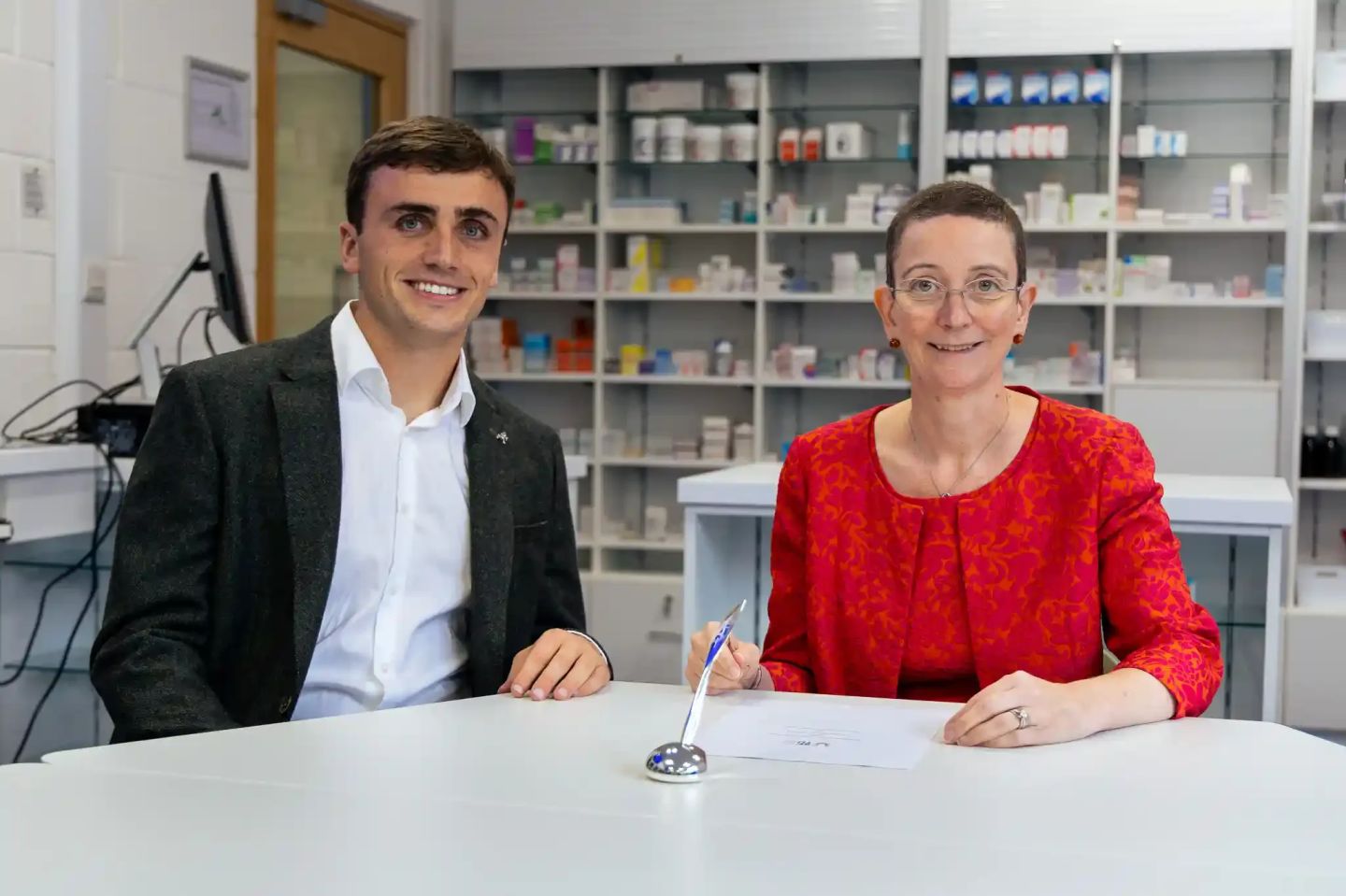
This episode focuses on a new course, the Master of Pharmacy at SETU – a five -year programme that integrates periods of experiential learning placement. Mary was joined in studio by Dr Claire Lennon, Head of the Department of Pharmacy; Dearbhla Walsh, Lecturer in Pharmacy Practice at the Department; and by Daragh Connolly who owns Connolly’s Pharmacy in Dungarvan, County Waterford
Listen on podcasts.setu.ieStories









Course Leader

Course question

Have a question about
this course?
Our team is here to help.
If you have any questions about this course, please get in touch and we'll be happy to assist.